ftui
FHEM Tablet UI (FTUI)
UI Builder Framework for FHEM
A modern, flexible UI builder framework for FHEM home automation.
Built with a clear intention: Keep it short and simple!
Version 3 - Built with Web Components using pure ES2020 JavaScript.
** Important Notes:**
- This version is not compatible with older FTUI versions (v1/v2)
- Supports multiple backends: FHEM and Home Assistant
- Active development - new features are continuously added

Table of Contents
- Installation
- Backend Configuration
- Update
- Docker Setup
- Development
- Usage
- Binding
- Pipes
- Colors
- Components
- Examples
- Support & Donation
- License
Installation
Quick Install
- Download and extract FTUI:
wget https://github.com/knowthelist/ftui/tarball/master -O /tmp/ftui.tar cd /tmp && tar xvzf /tmp/ftui.tar mv /tmp/knowthelist-ftui-*/www/ftui /opt/fhem/www - Customize your page:
- Edit
index.htmlaccording to your needs - Add your FHEM devices and readings
- Edit
- Access your UI:
- Open in browser:
http://<fhem-url>:8083/fhem/ftui/index.html
- Open in browser:
Backend Configuration
FTUI supports FHEM, Home Assistant, and ioBroker backends that can be used independently or simultaneously:
Notifications and Debugging
Notifications and console debugging are controlled independently in the page header:
<meta name="toast" content="1">
<meta name="debug" content="0">
The toast value is a maximum notification level:
0: no toast notifications1: important status changes and errors, such as connection changes2: level 1 plus sent backend commands3: level 2 plus refresh and incoming backend diagnostics; these disappear quickly
The debug value controls only verbose console output. It does not enable or disable toast notifications. toast_duration controls the normal toast duration in seconds, and toast_position controls its position.
FHEM Backend
FTUI works out-of-the-box with FHEM. Simply ensure your FHEM instance is running and accessible.
FHEMWEB Authentication
If your FHEMWEB instance is protected by HTTP authentication and FTUI shows an error like GET https://<servername>:8083/fhem/?XHR=1 401 (Authorization Required), then the browser is not authenticated for the FHEMWEB endpoint that FTUI is using.
FTUI does not currently send a custom Authorization header for FHEM requests on its own. In practice that means one of these setups is required:
- Open the FHEMWEB URL in the browser first and complete the authentication challenge there, then load the FTUI page in the same browser session.
- Serve FTUI from the same authenticated FHEMWEB origin so the browser can reuse that authenticated session.
- Put FTUI/FHEMWEB behind a reverse proxy that handles authentication before the request reaches FTUI.
- Expose a dedicated FHEMWEB instance or path for FTUI that is reachable without HTTP auth but still protected appropriately at the network level.
If FTUI should talk to a specific FHEMWEB path, set it explicitly in the page header:
<meta name="fhemweb_url" content="https://servername:8083/fhem/">
Important notes:
- The
fhemweb_urlvalue must point to the exact FHEMWEB endpoint FTUI should use. - A
401on?XHR=1means the authentication step failed before FTUI could talk to FHEM. - If you use a reverse proxy, make sure WebSocket upgrade requests are forwarded as well, because FTUI also uses a WebSocket connection for updates.
Home Assistant support stays dormant unless FTUI sees valid Home Assistant configuration and actual HA bindings.
If you are a FHEM-only user, leave homeAssistant.enabled at false or omit the homeAssistant block entirely in config.local.js.
Example usage:
<ftui-label [text]="WeatherDevice:temperature" unit="°C"></ftui-label>
<ftui-switch [(value)]="lamp1"></ftui-switch>
<ftui-button (value)="dummy1">Toggle</ftui-button>
Home Assistant Backend
To connect FTUI to Home Assistant, you need to configure CORS and create an access token.
Activation checklist:
- Add
enabled: trueinconfig.local.js - Set a valid Home Assistant
url - Set a valid long-lived
token - Use
ha:prefixed entities in your HTML
Setup Steps:
-
Configure CORS in Home Assistant
Add the following to your
configuration.yaml:http: cors_allowed_origins: - http://fhem.home.arpa:8083 - http://fhem:8083 - http://localhost:8083 use_x_forwarded_for: true trusted_proxies: - 172.168.101.0/24 - Create a Long-Lived Access Token
- In Home Assistant, go to: Profile → Security → Long-lived access tokens
- Click “Create Token”
- Give it a meaningful name (e.g., “FTUI Access”)
- Copy the generated token
- Configure FTUI
Create a config.local.js file in your FTUI installation directory (www/ftui/config.local.js):
   export const config = {
       homeAssistant: {
           enabled: true,
           url: 'http://homeassistant:8123',
           token: 'YOUR_LONG_LIVED_ACCESS_TOKEN_HERE',
       },
   };
Note: You can also edit
config.jsdirectly, but usingconfig.local.jsis recommended to avoid conflicts during updates. After changingconfig.local.js, reload the browser page.
Required switches:
enabled: trueturns on Home Assistant support for pages that useha:bindings.urlmust point to your Home Assistant instance.tokenmust be a Home Assistant long-lived access token.- Leave
enabled: falsefor FHEM-only setups.
-
Use Home Assistant in HTML
Prefix all Home Assistant entities with
ha::<ftui-label [text]="ha:weather.forecast_home:temperature" size="3" unit="°C"></ftui-label> <ftui-label [text]="ha:weather.forecast_home:humidity" size="3" unit="%"></ftui-label> <ftui-switch [(value)]="ha:light.living_room"></ftui-switch> <ftui-knob [value]="ha:sensor.outdoor_temperature" [color]="ha:sensor.outdoor_temperature | step('-99: blue, 10: ok, 20: warning, 25: danger')" width="130" offset-y="10" type="handle" min="-10" max="40" decimals="1" unit="°C" readonly has-value-text> </ftui-knob> -
Access Your Page:
- Open the dedicated HA example:
http://fhem:8083/fhem/ftui/examples/ha.html - Additional generic HA examples:
http://fhem:8083/fhem/ftui/examples/ha-basic.htmlandhttp://fhem:8083/fhem/ftui/examples/ha-mobile.html - Pages with
ha:bindings requireenabled: true,url, andtoken. - Private local dashboards should use the underscore convention in the FTUI root, for example
http://fhem:8083/fhem/ftui/_mobile_full.html. - Private partials can also use underscore names, for example
_mobile-solar.html. - If you see
Home Assistant support is disabled, thenenabled: trueis missing. - If you see
Home Assistant is not fully configured, thenurlortokenis missing or invalid.
- Open the dedicated HA example:
Dual Backend Setup
FTUI can communicate with both FHEM and Home Assistant simultaneously! This is perfect if you’re migrating between systems or want to use the best features of both platforms.
Configuration Example:
export const config = {
    homeAssistant: {
    enabled: true,
        url: 'http://homeassistant:8123',
        token: 'YOUR_HA_TOKEN_HERE',
    },
    // FHEM is automatically detected from the web server
};
Usage Example - Mixed Backends:
<!-- FHEM devices -->
<ftui-label [text]="FHEMWeather:temperature" unit="°C"></ftui-label>
<ftui-button (value)="FHEMDummy">FHEM Device</ftui-button>

<!-- Home Assistant devices -->
<ftui-switch [(value)]="ha:light.bedroom"></ftui-switch>
<ftui-label [text]="ha:sensor.temperature" unit="°C"></ftui-label>

<!-- Combined example -->
<ftui-grid base-width="100" base-height="100">
    <ftui-grid-tile row="1" col="1">
        <ftui-row>
            <ftui-column>
                <h3>FHEM Devices</h3>
                <ftui-button (value)="lamp1">FHEM Lamp</ftui-button>
            </ftui-column>
            <ftui-column>
                <h3>Home Assistant</h3>
                <ftui-switch [(value)]="ha:light.kitchen"></ftui-switch>
            </ftui-column>
        </ftui-row>
    </ftui-grid-tile>
</ftui-grid>
Key Points:
- Use no prefix for FHEM devices:
devicename:reading - Use
ha:prefix for Home Assistant:ha:entity.name - All configured backends update through FTUI bindings
- Pipes and bindings work with both backends
ioBroker Backend
ioBroker support uses configurable HTTP endpoints and can receive live updates through the official ioBroker.ws adapter. For the REST API adapter (typically port 8093), add this to www/ftui/config.local.js:
Prerequisite: Install and start a configured REST API adapter instance in ioBroker. The Admin UI at port 8081 does not provide these REST endpoints. Verify the adapter’s configured port and use that port in ioBroker.url; 8093 is only the common default.
export const config = {
    ioBroker: {
        enabled: true,
        url: 'http://iobroker:8093',
        websocketUrl: 'http://iobroker:8084',
        username: '',
        password: '',
        token: '',
        stateEndpoint: '/v1/command/getStates',
        stateQueryParameter: 'pattern',
        writeEndpoint: '/v1/state/{id}',
        writeMethod: 'GET',
        writePayload: null,
        writeQueryParameters: { value: '$value' },
    },
};
websocketUrl is optional. When configured, FTUI loads the pure-WebSocket client from <websocketUrl>/socket.io/socket.io.js, authenticates, subscribes to the io: state IDs, and applies stateChange events immediately. REST remains the initial-state and fallback transport. Install and enable the ioBroker.ws adapter, usually on port 8084; this is not the old Socket.IO adapter. If authentication is enabled, provide an ioBroker access token or an authenticated browser session. The REST username/password settings are not used as WebSocket Basic Authentication.
Use the io: prefix for state IDs. The default state response accepts ioBroker’s object-map format ({ "state.id": { "val": ... } }) and array format:
<ftui-label [text]="io:shelly.0.temperature"></ftui-label>
<ftui-switch [(value)]="io:javascript.0.light"></ftui-switch>
If the selected ioBroker API uses different paths, query parameters, authentication, write methods, or request bodies, change the corresponding options above. $id and $value are replaced with the state ID and value. Keep credentials in config.local.js; do not commit them.
Update
To update FTUI to the latest version via FHEM:
update all https://raw.githubusercontent.com/knowthelist/ftui/master/controls_ftui.txt
Enter this command in the FHEM command field of FHEMWEB.
Docker Setup
You can host FTUI on your own web server using Docker instead of via FHEMWEB.
Option A – Build from source (recommended for this repo)
# Build and start
docker compose up -d

# Stop
docker compose down
The included docker-compose.yml builds the image from the local source tree and mounts your index.html for easy customisation.
Option B – Use the pre-built Docker Hub image
- Prepare your
index.html: Add the FHEMWEB URL to the<head>section:<meta name="fhemweb_url" content="http://<your_fhem_url>:8083/fhem/"> - Run the container:
docker run -d \ -p 8080:80 \ -v "$(pwd)/index.html:/usr/share/nginx/html/index.html:ro" \ --restart unless-stopped \ --name ftui \ knowthelist/ftui - Access your UI:
- Open in browser:
http://<docker_host>:8080
- Open in browser:
Docker Compose (pre-built image):
services:
  ftui:
    image: knowthelist/ftui
    container_name: ftui
    ports:
      - "8080:80"
    volumes:
      - ./index.html:/usr/share/nginx/html/index.html:ro
    restart: unless-stopped
Development
For developers who want to contribute or customize FTUI:
- Clone the repository:
cd ~ git clone https://github.com/knowthelist/ftui.git - Link to FHEM’s www directory:
ln -s $HOME/ftui/www/ftui /opt/fhem/www/ftui_dev - Access the development version:
- Open:
http://<fhem-url>:8083/fhem/ftui_dev/index.html
- Open:
- Snippet Tester:
- Test components live:
http://<fhem-url>:8083/fhem/ftui_dev/ftui-snippet-tester.html - Paste HTML snippets and see them rendered in real-time
- Test components live:
Usage
Add FTUI web components to your HTML code. Components support powerful data binding and real-time updates.
Basic Examples:
Button:
<ftui-button (value)="dummy1">on/off</ftui-button>
Label:
<ftui-label [text]="dummy1"></ftui-label>
Icon with dynamic properties:
<ftui-icon
    [name]="dummy1 | map('on: lightbulb-on, off: lightbulb')"
    [color]="temperature | step('0: success, 50: warning, 80: danger')">
</ftui-icon>
Binding
FTUI uses a powerful data binding system inspired by modern frameworks. Bindings connect your HTML elements to FHEM/Home Assistant data sources.
No Binding - Fixed Value
<ftui-label color="danger">demo</ftui-label>
Input Binding (One-Way: Backend → UI)
Updates the UI when the backend reading changes.
Long format:
<ftui-label get-color="dummy1:color">demo</ftui-label>
Short format (recommended):
<ftui-label [color]="dummy1:color">demo</ftui-label>
Reading Format:
[attribute]="DEVICE:READING:PROPERTY"
- DEVICE: Name of the FHEM/HA device (e.g.,
lamp1,WeatherLocal,ha:light.bedroom) - READING: Name of the reading (e.g.,
state,temperature) - Default:STATE - PROPERTY: Property of the reading - Default:
valuevalue- The current valuetime- Timestamp when the reading was setupdate- Last update timestamp in FTUIinvalid-trueif reading doesn’t exist
Example - Show timestamp:
<ftui-label [text]="WeatherLocal:state:time | toDate() | format('HH:mm:ss')"></ftui-label>
Attribute Binding
Set HTML attributes dynamically:
<ftui-label [attr.data-my]="dummy1:status">demo</ftui-label>
Output Binding (One-Way: UI → Backend)
Updates the backend when UI changes.
Long format:
<ftui-button set-value="dummy1"></ftui-button>
Short format (recommended):
<ftui-button (value)="dummy1"></ftui-button>
Two-Way Binding (Bidirectional)
Synchronizes both directions automatically.
Long format:
<ftui-button getset-value="dummy1"></ftui-button>
Short format - “Banana in a Box” (recommended):
<ftui-button [(value)]="dummy1"></ftui-button>
Local Binding
The device name local is reserved for client-side binding that doesn’t sync with backends.
<link href="themes/mobile-dark-theme.css" rel="stylesheet"
      ftui-binding [disabled]="local:dark">
Built-in local variables:
local:dark- Automatically set totruewhen OS switches to dark mode
Events
Components provide events that trigger on attribute changes. The $event object contains a detail property with the changed data.
<ftui-colorpicker @color-change="console.log($event.detail.hexString)"></ftui-colorpicker>
<ftui-dropdown
    [list]="deviceList:list"
    [(value)]="selectedDevice"
    @value-change="console.log('Selected:', $event.detail)">
</ftui-dropdown>
<ftui-dropdown
  list="Living Room,Kitchen,Bedroom"
  vallist="living,kitchen,bedroom"
  value="kitchen">
</ftui-dropdown>
Use events to communicate between components and trigger custom JavaScript.
Pipes
Binding values can be transformed using pipe functions. Multiple pipes can be chained together.
Available Pipes:
| Pipe | Description | Example |
|---|---|---|
part(number) |
Extract part of string by index | "one two three" \| part(1) → "two" |
toDate(format) |
Convert to date object | "2024-01-15" \| toDate() |
toBool() |
Convert to boolean | "1" \| toBool() → true |
toInt() |
Convert to integer | "3.14" \| toInt() → 3 |
toNumber() |
Convert to float | "3.14" \| toNumber() → 3.14 |
format(string) |
Format date/time | date \| format('YYYY-MM-DD HH:mm') |
humanized() |
Human-readable duration | 3600 \| humanized() → "1 hour" |
round(decimals) |
Round number | 3.14159 \| round(2) → 3.14 |
fix(decimals) |
Fixed decimal places | 3.1 \| fix(2) → "3.10" |
roundMoney() |
Format as currency | 1234.5 \| roundMoney() → "1,234.50" |
slice(start, end) |
Extract substring | "hello" \| slice(0,2) → "he" |
encode() |
URL encode | "hello world" \| encode() → "hello%20world" |
add(number) |
Add to value | 10 \| add(5) → 15 |
multiply(number) |
Multiply value | 5 \| multiply(2) → 10 |
divide(number) |
Divide value | 10 \| divide(2) → 5 |
replace(find, replace) |
Replace text | "hello" \| replace('h', 'H') → "Hello" |
map('in:out,...') |
Map values | "on" \| map('on:green,off:red') → "green" |
filter('val,val,...') |
Filter matching values | "test" \| filter('test,demo') → "test" |
step('val:out,...') |
Step-based mapping | 15 \| step('0:cold,10:ok,20:warm') → "ok" |
scale(minIn,maxIn,minOut,maxOut) |
Scale value range, clamped to bounds | 50 \| scale(0,100,0,255) → 127.5 |
ago() |
Time ago | timestamp \| ago() → "2 hours ago" |
till() |
Time until | timestamp \| till() → "in 3 hours" |
timeFormat(format,inputMode,formatMode) |
Format time | 3661 \| timeFormat('HH:mm:ss') → "01:01:01" |
minusBlue(threshold) |
Return blue if below threshold | 5 \| minusBlue(10) → "blue" |
contains(value) |
Check if contains value | "hello" \| contains('ell') → true |
not() |
Logical NOT | true \| not() → false |
is(value) |
Check equality | "on" \| is('on') → true |
isNot(value) |
Check inequality | "on" \| isNot('off') → true |
pad(count, char) |
Pad string with character | "5" \| pad(3,'0') → "005" |
append(text) |
Append text | "hello" \| append(' world') → "hello world" |
prepend(text) |
Prepend text | "world" \| prepend('hello ') → "hello world" |
capitalize() |
Capitalize first letter | "hello" \| capitalize() → "Hello" |
Input Examples (Backend → UI):
<!-- Chain multiple pipes -->
<ftui-label [text]="WeatherLocal:state | part(4) | toInt() | multiply(2) | round(1)"></ftui-label>

<!-- Map values to text -->
<ftui-icon [name]="lamp:state | map('on:lightbulb-on,off:lightbulb')"></ftui-icon>

<!-- Step-based color -->
<ftui-label
    [text]="temperature"
    [color]="temperature | step('0:blue,10:green,20:yellow,30:red')">
</ftui-label>

<!-- Format timestamp -->
<ftui-label [text]="sensor:state:time | toDate() | format('DD.MM.YYYY HH:mm')"></ftui-label>
Output Examples (UI → Backend):
<!-- Remove # from color before sending -->
<ftui-colorpicker (hex)="HUEDevice:rgb | replace('#','')"></ftui-colorpicker>

<!-- Scale slider value -->
<ftui-slider (value)="dimmer:pct | scale(0,100,0,255)"></ftui-slider>
Colors
FTUI provides a comprehensive color palette with named colors for consistent theming.
Color Categories
Color values shown are from the default ftui-theme. Available themes may use different values.
Main Colors:
primary- #20639b - Primary brand colorsecondary- #173f5f - Secondary accent colorlight- #bfbfbf - Light theme colormedium- #5d5d5d - Medium graydark- #3f3f3f - Dark theme color
Status Colors:
success- #05aaad - Positive/success statewarning- #eeca82 - Warning/caution statedanger- #db5d3a - Error/danger state
Alternative Status:
ok- Same assuccesserror- Same asdanger
Spectrum Colors:
red- #db5d3aorange- #f8b13eyellow- #eeca82green- #05aaadblue- #3062a0violet- #9400d3
Neutral Colors:
white- #fffblack- #000gray- Same asmediumbrown- #bf7a37grid- Inherits from grid tile backgroundtranslucent- Semi-transparent overlay
Available Themes
FTUI includes several pre-built themes. Include them in your HTML <head>:
Default Theme (Dark):
<link href="themes/ftui-theme.css" rel="stylesheet">
Bright Theme (Light):
<link href="themes/bright-theme.css" rel="stylesheet">
Clean, bright interface with light backgrounds. Colors: Primary #3880ff, Success #32a054, Danger #ed553b
Vivid Theme (Vibrant):
<link href="themes/vivid-theme.css" rel="stylesheet">
High-contrast vibrant colors. Colors: Primary #007bff, Success #28a745, Warning #ffc107
Retro Theme:
<link href="themes/retro-theme.css" rel="stylesheet">
Classic retro styling with warm tones.
Mobile Themes:
<!-- Light mobile theme -->
<link href="themes/mobile-theme.css" rel="stylesheet">

<!-- Dark mobile theme -->
<link href="themes/mobile-dark-theme.css" rel="stylesheet">

<!-- iOS-inspired theme -->
<link href="themes/mobile-ios.css" rel="stylesheet">
Usage Examples
<ftui-button color="primary">Primary Button</ftui-button>
<ftui-label color="danger">Error Message</ftui-label>
<ftui-icon name="warning" color="warning"></ftui-icon>

<!-- Dynamic color based on value -->
<ftui-label
    [text]="temperature"
    [color]="temperature | step('0:blue,15:green,25:yellow,30:red')">
</ftui-label>

<!-- Multiple colored components -->
<ftui-row>
  <ftui-button color="success">Success</ftui-button>
  <ftui-button color="warning">Warning</ftui-button>
  <ftui-button color="danger">Danger</ftui-button>
</ftui-row>
Components
FTUI provides a rich set of web components for building interactive UIs.
Layout Components
- Tab - Tabbed navigation
- Grid - Responsive grid layout
- Circlemenu - Circular menu
- Row - Horizontal layout container
- Column - Vertical layout container
- Cell - Grid cell container
- View, ViewStage, ViewSection, ViewItem - View hierarchy for mobile UIs
- Swiper - Touch-enabled slider/carousel
Display Components
- Label - Text display with formatting
- Icon - Icon display with color and size options
- Image - Image display with auto-refresh
- Badge - Notification badges
- Clock - Time display
- Weather - Weather information display
Input Components
- Button - Interactive button
- SegmentedButton - Multi-option button group
- Knob - Rotary knob control
- Slider - Linear slider control
- Checkbox - Toggle checkbox
- Dropdown - Selection dropdown
- Colorpicker - Color selection tool
Data Visualization
- Chart - Charts and graphs (powered by Chart.js)
- Medialist - Media list display
- Solar Flow - Energy flow visualization for solar, battery, grid, and home power
Special Components
- Speak - Text-to-speech output
Note: All components support the following common attributes:
hidden- Hide componentdisabled- Disable interactionreadonly- Read-only modemargin- Outer spacingpadding- Inner spacing
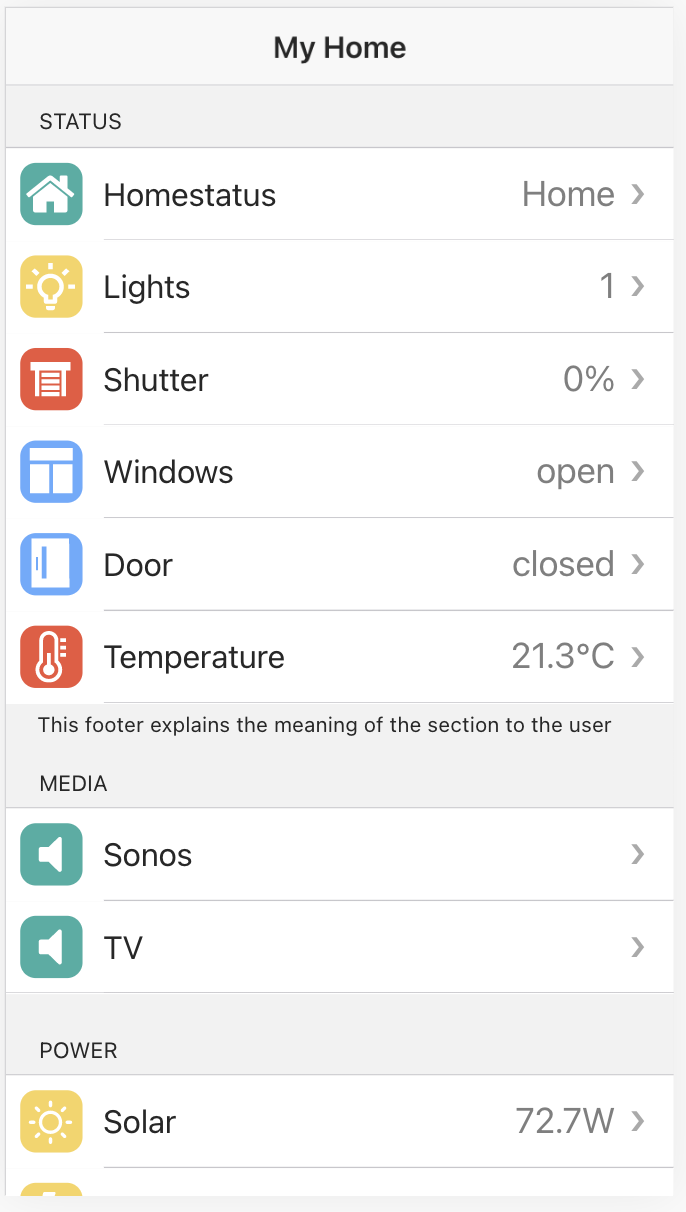
Mobile UI
FTUI is perfect for creating responsive mobile interfaces using the ftui-view component.
Component Reference
Button
Interactive buttons with multiple states and styles.
| Attribute | Description | Type | Default |
|---|---|---|---|
| color | Color palette selection | "primary" | "secondary" | "success" | "warning" | "danger" | "light" | "medium" | "dark" |
"primary" |
| fill | Button fill style | "clear" | "outline" | "solid" |
"solid" |
| size | Button size | "small" | "normal" | "large" |
"normal" |
| shape | Button shape | "round" | "normal" | "circle" |
"normal" |
| value | Current state value | String | "off" |
| states | Available states (comma-separated) | String | "on,off" |
Example:
<ftui-button color="success" fill="solid" shape="round" [(value)]="lamp1">
    Toggle Light
</ftui-button>
Label
Display text with formatting options.
| Attribute | Description | Type | Default | Example |
|---|---|---|---|---|
| text | Text to display | String | "" |
|
| color | Text color | Color name | "" |
"danger" |
| unit | Unit suffix | String | "" |
"°C" |
| interval | Auto-reload interval (seconds) | Number | 0 |
60 |
| size | Font size | Number | String | 0 |
3 or "80%" or "12px" |
Size Mapping
When size is a number, it maps to these font sizes:
| Size | Font Size | Size | Font Size |
|---|---|---|---|
| -4 | 0.125em | 0 | 1em |
| -3 | 0.25em | 1 | 1.25em |
| -2 | 0.5em | 2 | 1.5em |
| -1 | 0.75em | 3 | 1.75em |
| 4 | 2em | ||
| 5 | 2.5em | ||
| 6-12 | 3em-12em |
Size can also be specified as %, px, or em strings.
Examples:
<ftui-label [text]="temperature" size="3" unit="°C" color="primary"></ftui-label>
<ftui-label text="System Status" size="80%" color="success"></ftui-label>
<ftui-label [text]="sensor:state" size="12px"></ftui-label>
Image
Display images with refresh capabilities.
| Attribute | Description | Type | Default |
|---|---|---|---|
| base | Base URL path | String | "" |
| src | Image filename or full URL | String | "" |
| width | Image width | Number | "auto" |
"auto" |
| height | Image height | Number | "auto" |
"auto" |
| interval | Auto-reload interval (seconds) | Number | 0 |
| refresh | Reload trigger attribute | String | "" |
| nocache | Bypass cache | Boolean | false |
Examples:
<!-- Simple image -->
<ftui-image src="weather.png" width="200"></ftui-image>

<!-- Auto-refresh every 30 seconds -->
<ftui-image src="camera/snapshot.jpg" interval="30" nocache></ftui-image>

<!-- Refresh on device change -->
<ftui-image
    base="/fhem/images/"
    src="floorplan.png"
    [refresh]="motion_sensor:state">
</ftui-image>
Solar Flow
Visualize power flow between solar input, battery, inverter, home, and grid.
Use kebab-case HTML attributes for component properties. For example, maxInverterPower in the component is configured as max-inverter-power in markup, and maxGridPower is configured as max-grid-power.
The soc attribute now renders correctly even when the value is exactly 100, so no binding workaround like | add(1) is needed.
Example:
<ftui-solar-flow
  [solar-power]="Zendure_Hub2000:properties_solarInputPower"
  [soc]="Zendure_Hub2000:properties_electricLevel"
  [inverter-power]="Zendure_Hub2000:properties_outputHomePower"
  max-inverter-power="6000"
  [home-power]="LeistungGesamt:state"
  [grid-power]="SmartMeter:GS303_Power_cur"
  max-grid-power="5000"
  [battery-current]="Zendure_Hub2000:BatCurrent"
  [grid-input-power]="Zendure_Hub2000:properties_gridInputPower">
</ftui-solar-flow>
Badge
Display notification badges that disappear when empty.
| Attribute | Description | Type | Default |
|---|---|---|---|
| color | Badge color | Color name | "primary" |
| text | Badge content | String | "" |
Examples:
<!-- Static badge -->
<ftui-badge text="5" color="danger"></ftui-badge>

<!-- Dynamic notification count -->
<ftui-badge [text]="notifications:count" color="warning"></ftui-badge>
Speak
Text-to-speech synthesis using the Web Speech API.
| Attribute | Description | Type | Default |
|---|---|---|---|
| lang | Language code | "en-US" | "de-DE" | etc. |
User agent default |
| pitch | Voice pitch (0.0-2.0) | Float | 0.9 |
| rate | Speech rate (0.1-10) | Float | 1.0 |
| volume | Volume (0.0-1.0) | Float | 1.0 |
| text | Text to speak | String | "" |
Examples:
<!-- Announce temperature changes -->
<ftui-speak
    lang="en-US"
    rate="1.2"
    [text]="temperature | format('Temperature is now {0} degrees')">
</ftui-speak>

<!-- German announcement -->
<ftui-speak
    lang="de-DE"
    pitch="1.0"
    [text]="doorbell:state | map('on:Jemand ist an der Tür')">
</ftui-speak>
Colorpicker
Advanced color selection supporting RGB, HSL, and hex formats.
| Attribute | Description | Type | Default |
|---|---|---|---|
| hex | RGB hex value (#ffffff) | String | "" |
| hue | Hue (0-360) | Number | 0 |
| saturation | Saturation (0-100) | Number | 0 |
| brightness | Brightness (0-100) | Number | 0 |
Examples:
<!-- Simple hex color picker -->
<ftui-colorpicker [(hex)]="rgbLamp:rgb"></ftui-colorpicker>

<!-- HSL color picker for Hue lights -->
<ftui-colorpicker
    [(hue)]="ha:light.bedroom:hs_color[0]"
    [(saturation)]="ha:light.bedroom:hs_color[1]">
</ftui-colorpicker>

<!-- With change event -->
<ftui-colorpicker
    [(hex)]="colorLight:hex"
    @color-change="console.log('New color:', $event.detail.hexString)">
</ftui-colorpicker>
Chart
Powerful charting component powered by Chart.js.
Supported Chart Types:
- Line chart
- Dashed line chart
- Dotted line chart
- Bar chart
- Radar chart
- Doughnut and Pie chart
- Polar chart
- Bubble chart
- Area chart
- Mixed types
Main Component: ftui-chart
| Attribute | Description | Type | Default |
|---|---|---|---|
| title | Chart title | String | "" |
| type | Chart type | String | "line" |
| width | Chart width | String | "" |
| height | Chart height | String | "" |
| unit | Time unit | "day" | "hour" | "minute" |
"day" |
| offset | Time offset | Number | 0 |
| prefetch | Data prefetch amount | Number | 0 |
| extend | Extend data range | Boolean | false |
| noscale | Disable auto-scaling | Boolean | false |
| no-y | Hide Y-axis | Boolean | false |
| no-y1 | Hide secondary Y-axis | Boolean | false |
| no-x | Hide X-axis | Boolean | false |
| y-min | Y-axis minimum | Number | 0 |
| y-max | Y-axis maximum | Number | 0 |
| y1-min | Y1-axis minimum | Number | 0 |
| y1-max | Y1-axis maximum | Number | 0 |
| y-label | Y-axis label | String | "" |
| y1-label | Y1-axis label | String | "" |
| grid-line-color | Grid line color. Use any CSS color, or transparent to hide all grid lines. Falls back to --chart-grid-line-color CSS variable, then to --dark-color |
Color | "" |
Child Component: ftui-chart-data
Note on
colorvsborder-color: Usecoloras the primary way to set the line/series color. FTUI derivesborderColorandpointBackgroundColorautomatically fromcolor. Settingborder-colordirectly is overwritten internally when the data loads.
Data source attributes
| Attribute | Description | Type | Default |
|---|---|---|---|
| log | FHEM DbLog device name | String | "-" |
| file | Log file argument (- = current file, CURRENT = file(s) matching the requested date range) |
String | "-" |
| spec | Column/reading specification | String | "4:.*" |
| start-date | Override series start date | Date string | "" |
| end-date | Override series end date | Date string | "" |
| prefetch | Extra time range to fetch (seconds) | Number | 0 |
| extend | Extend last known value to now/end | Boolean | false |
| update | Reading whose change triggers a re-fetch | String | "" |
| offset | Add a numeric offset to every data value | Number | 0 |
For FHEM FileLog devices with date-based rotation (for example
Heizoel-%Y.log), use file="CURRENT" instead of the default file="-".
To plot a range spanning multiple log files, enable FHEM’s
createGluedFile attribute on the FileLog device:
<ftui-chart-data log="FileLog_Heizoel" file="CURRENT"
                 spec="4:.*"></ftui-chart-data>
file="-" deliberately reads only the currently open log file. The
createGluedFile setting is evaluated by FHEM for CURRENT requests; it is
not used for -.
Series identity & layout
| Attribute | Description | Type | Default |
|---|---|---|---|
| label | Legend label. Supports $min, $max, $avg, $last, $sum placeholders |
String | "" |
| type | Series type: line, dashed, bar, bubble, radar |
String | "line" |
| y-axis-id | Assign series to Y-axis: y (left) or y1 (right) |
"y" | "y1" |
"y" |
| stack | Stack group ID. Series with the same ID are stacked | String | "" |
| hidden | Start with series hidden (toggle in legend) | Boolean | false |
| unit | Unit string appended to values (informational only) | String | "" |
Line & fill appearance
| Attribute | Description | Type | Default |
|---|---|---|---|
| color | Primary series color — sets line, points and (calculated) fill | Color | Primary theme color |
| background-color | Explicit fill/bar background color. When omitted FTUI calculates a semi-transparent version of color |
Color | "" |
| border-width | Line width in pixels | Number | 1.2 |
| fill | Fill the area below the line down to the x-axis | Boolean | false |
| tension | Bezier curve tension. 0 = straight segments, 0.4 = smooth curve. Only for line/dashed/radar |
Number | 0.0 |
| stepped | Stepped line — connects points with horizontal/vertical steps instead of diagonals. Only for line/dashed |
Boolean | false |
Point appearance
| Attribute | Description | Type | Default |
|---|---|---|---|
| point-radius | Radius of data-point circles in pixels. 0 hides all points |
Number | 2 |
Type details
type value |
Rendered as | Notes |
|---|---|---|
line |
Solid line | Default. Supports tension, stepped, fill |
dashed |
Dashed line | Virtual type — rendered as line with dash pattern [6, 4]. Supports tension, stepped, fill |
dotted |
Dotted line | Virtual type — rendered as line with dot pattern [2, 4]. Supports tension, stepped, fill |
bar |
Bar chart | tension and stepped are disabled for bars |
bubble |
Bubble chart | Y-value controls bubble vertical position; combine with stepped for Gantt-style blocks |
radar |
Radar/spider chart | Supports tension |
Examples:
<!-- Simple temperature chart -->
<ftui-chart title="Temperature History" height="300px">
    <ftui-chart-data
        label="Living Room"
        log="DBLogDevice"
        file="history"
        spec="TempSensor:temperature"
        border-color="red"
        fill>
    </ftui-chart-data>
</ftui-chart>

<!-- Multi-series chart with auto-update -->
<ftui-chart title="Climate Data" type="line" height="400px">
    <ftui-chart-data
        label="Temperature"
        log="DBLog"
        file="history"
        spec="Climate:temperature"
        unit="°C"
        border-color="orange"
        [update]="Climate:temperature:time">
    </ftui-chart-data>

    <ftui-chart-data
        label="Humidity"
        log="DBLog"
        file="history"
        spec="Climate:humidity"
        unit="%"
        border-color="blue"
        y-axis-id="1">
    </ftui-chart-data>
</ftui-chart>

<!-- Mixed chart types -->
<ftui-chart title="Energy Consumption">
    <ftui-chart-data
        label="Daily Usage"
        type="bar"
        log="DBLog"
        file="history"
        spec="Power:daily"
        background-color="green">
    </ftui-chart-data>

    <ftui-chart-data
        label="Average"
        type="line"
        log="DBLog"
        file="history"
        spec="Power:average"
        border-color="red"
        tension="0.4">
    </ftui-chart-data>
</ftui-chart>
Icon
Display icons from the built-in icon library.
| Attribute | Description | Type | Default |
|---|---|---|---|
| type | Icon type | String | "" |
| path | Icon path | String | "" |
| name | Icon name | String | "" |
| color | Icon color | Color name | "" |
| rgb | RGB color value | String | "" |
| size | Icon size | Number | String | 0 |
| height | Icon height | String | "" |
| width | Icon width | String | "" |
| rotate | Rotation in degrees | Number | 0 |
Size Mapping (same as Label)
When size is a number, it maps to font sizes from 0.125em to 12em.
Examples:
<!-- Simple icon -->
<ftui-icon name="lightbulb" color="yellow" size="3"></ftui-icon>

<!-- Dynamic icon based on state -->
<ftui-icon
    [name]="lamp:state | map('on:lightbulb-on,off:lightbulb')"
    [color]="lamp:state | map('on:yellow,off:gray')"
    size="4">
</ftui-icon>

<!-- Rotated icon -->
<ftui-icon name="arrow-up" rotate="45" color="primary" size="2"></ftui-icon>
Layout Components
Build complex layouts with Row, Column, and Cell components using a flexible CSS Flexbox-based system.
Component Overview
<ftui-row>- Horizontal container (flex-direction: row)<ftui-column>- Vertical container (flex-direction: column)<ftui-cell>- Generic flexible container for content grouping<ftui-grid>+<ftui-grid-tile>- Responsive grid system with tile positioning
Common Attributes
All layout components support:
| Attribute | Values | Description |
|---|---|---|
align-items |
left, right, top, bottom, center, around, stretch |
Flexbox alignment control |
margin |
CSS value (e.g., "1", "1em", "0 0 0 10px") |
Outer spacing |
padding |
CSS value | Inner spacing |
width |
CSS value (e.g., "50%", "200px") |
Component width |
height |
CSS value (e.g., "70%", "600px") |
Component height |
gap |
CSS value (e.g., "0.5") |
Spacing between child elements |
Practical Examples
Basic Row Layout - Horizontal button arrangement:
<ftui-row align-items="stretch">
  <ftui-button [(value)]="device1">Device 1</ftui-button>
  <ftui-button [(value)]="device2">Device 2</ftui-button>
  <ftui-button [(value)]="device3">Device 3</ftui-button>
</ftui-row>
Nested Row & Column - Multi-room light controls:
<ftui-row>
  <ftui-column>
    <ftui-row>
      <ftui-label text="Living Room"></ftui-label>
      <ftui-button shape="circle" [(value)]="room1">
        <ftui-icon name="lightbulb"></ftui-icon>
      </ftui-button>
    </ftui-row>
    <ftui-row>
      <ftui-label text="Kitchen"></ftui-label>
      <ftui-button shape="circle" [(value)]="room2">
        <ftui-icon name="lightbulb"></ftui-icon>
      </ftui-button>
    </ftui-row>
  </ftui-column>
  <ftui-column>
    <ftui-row>
      <ftui-label text="Bedroom"></ftui-label>
      <ftui-button shape="circle" [(value)]="room3">
        <ftui-icon name="lightbulb"></ftui-icon>
      </ftui-button>
    </ftui-row>
  </ftui-column>
</ftui-row>
Column with Alignment - Sensor data display:
<ftui-row>
  <ftui-column align-items="left" margin="1">
    <ftui-label text="Thermostat"></ftui-label>
    <ftui-label text="Radiator"></ftui-label>
    <ftui-label text="Heater"></ftui-label>
  </ftui-column>
  <ftui-column align-items="left" margin="1">
    <ftui-label [text]="device:temp1" unit="°C"></ftui-label>
    <ftui-label [text]="device:temp2" unit="°C"></ftui-label>
    <ftui-label [text]="device:temp3" unit="°C"></ftui-label>
  </ftui-column>
</ftui-row>
Cell for Content Grouping - Weather display with gap spacing:
<ftui-cell align-items="left" gap="0.5">
  <ftui-label color="medium" size="1">Temperature</ftui-label>
  <ftui-label [text]="weather:temp | fix(1)" unit="°" size="8" thin></ftui-label>
</ftui-cell>
<ftui-cell align-items="left" margin="1em 0 0" gap="0.5">
  <ftui-label color="medium">Rain</ftui-label>
  <ftui-label [text]="weather:rain" size="3" unit="mm" thin></ftui-label>
</ftui-cell>
Responsive Height - Full-height column:
<ftui-column height="70%">
  <ftui-button>Button 1</ftui-button>
  <ftui-button>Button 2</ftui-button>
</ftui-column>
Tips
- Nesting: Freely nest Row inside Column and vice versa for complex layouts
- Alignment: Use
align-items="around"for evenly distributed spacing - Margins: Support CSS shorthand:
margin="1"(all sides) ormargin="0 0 0 10px"(top right bottom left) - Mobile: Combine with
<ftui-view>components for mobile-optimized interfaces
Examples
Explore the full capabilities of FTUI with these live examples:
Layout & Structure
- Tab - Tabbed navigation
- Grid - Responsive grid layouts
- Circlemenu - Circular menu navigation
Display Components
Input & Control
- Button - Buttons and interactions
- Knob - Rotary controls
- Slider - Linear sliders
- Checkbox - Toggle controls
- Dropdown - Selection menus
- Colorpicker - Color selection
- SegmentedButton - Multi-option buttons
Advanced Components
- Chart - Data visualization
- Popup - Modal dialogs
- Swiper - Touch carousels
- Medialist - Media galleries
- Departure - Transit information
- Speak - Text-to-speech
Mobile UIs
- View (Plain) - Basic mobile interface
- View (Full) - Complete mobile UI (FHEM-only public example)
- Home Assistant - Dedicated Home Assistant example
- Home Assistant (Basic) - Generic HA grid example
- Home Assistant (Mobile) - Generic HA mobile example
Files prefixed with _ are private/local dashboard variants and are intentionally not part of the public example set.
Theming
Troubleshooting
Common Issues
Backend Connection Errors:
- Verify FHEM/Home Assistant is running and accessible
- Check CORS settings for Home Assistant
- Ensure access token is valid and has appropriate permissions
- Check network connectivity between client and server
Components Not Rendering:
- Open browser console (F12) to check for JavaScript errors
- Verify component names are correctly spelled
- Ensure all required attributes are provided
- Check that backend prefix (
ha:) is used correctly
Updates Not Working:
- Clear browser cache
- Verify reading names match your FHEM/HA configuration
- Check that bindings use correct syntax
[attribute]="device:reading" - Ensure FHEM DbLog is properly configured for chart components
Contributing
Contributions are welcome! If you’d like to contribute:
- Fork the repository
- Create a feature branch
- Make your changes
- Test thoroughly
- Submit a pull request
Report bugs and feature requests on the GitHub Issues page.
Donation
Support the continued development of this versatile UI framework:

Many thanks to all donors and contributors!
License
This project is licensed under the MIT License.
Community & Support
- Documentation: GitHub Pages
- Source Code: GitHub Repository
- Issues: Bug Reports & Feature Requests
- FHEM Forum: FHEM Community
Built with ❤️ for the FHEM and Home Assistant communities